
UAE · 2027 Rule Changes · Episode 11
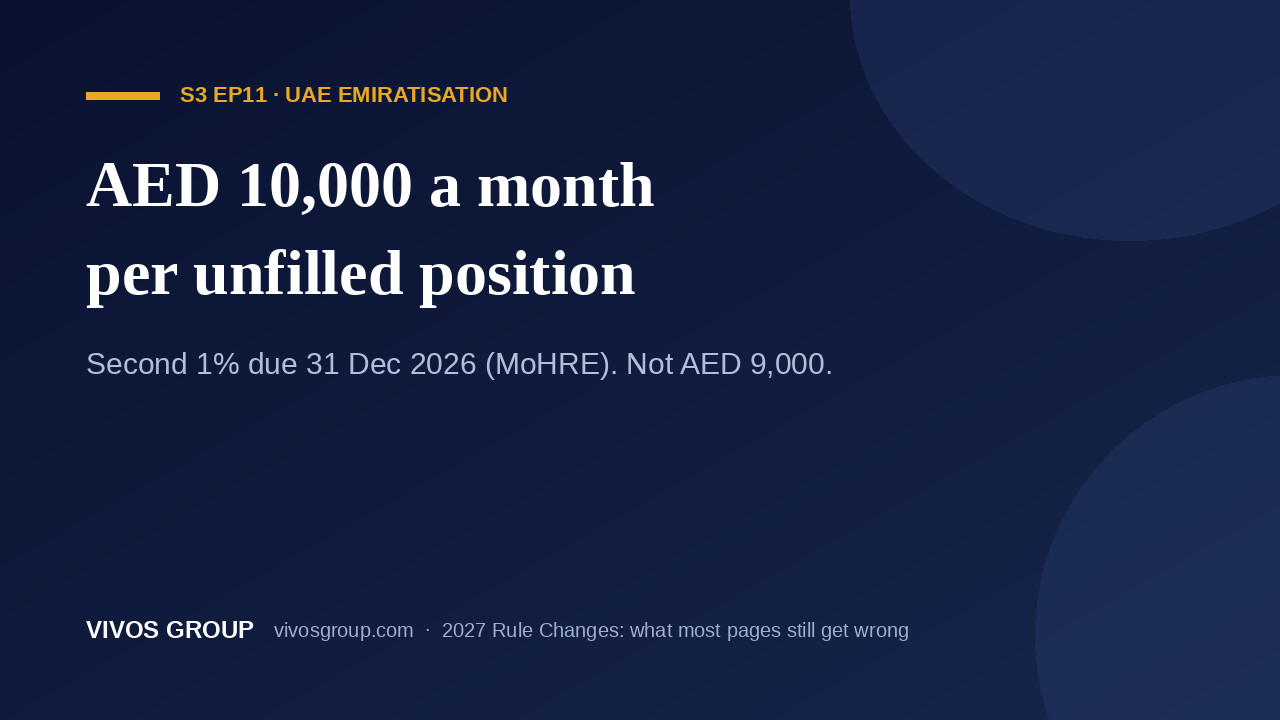
UAE Emiratisation deadline 31 December 2026: private companies with 50 or more employees must raise Emiratis in skilled jobs by 2% a year, an overall 10% increase by the end of 2026. MoHRE's schedule (AED 7,000 a month in 2023, plus AED 1,000 a year) and its June 2026 statement give AED 10,000 a month (AED 120,000 a year) for each position not filled with an Emirati. AED 9,000 was the 2025 rate.
What some pages still say: "In 2026, the monthly penalty is AED 9,000 per unfilled position".
What MoHRE says: AED 7,000 a month for 2023, rising by AED 1,000 a year until 2026 (MoHRE, 6 January and 26 April 2023), which gives AED 10,000 for 2026. MoHRE's statement of 22 June 2026, reported by WAM, says the same: AED 10,000 a month "for each position they fail to fill with an Emirati citizen". AED 108,000 a year is the 2025 figure.
Key facts (27 October 2026)
- UAE Emiratisation deadline 31 December 2026: private companies with 50 or more employees must raise Emiratis in skilled jobs by 2% a year, an overall 10% increase by the end of 2026.
- MoHRE's schedule (AED 7,000 a month in 2023, plus AED 1,000 a year) and its June 2026 statement give AED 10,000 a month (AED 120,000 a year) for each position not filled with an Emirati.
- AED 9,000 was the 2025 rate.
- Private companies with 50 or more employees need "2% annual growth of Emirati employees in skilled positions" (MoHRE), 1% each half year, towards an overall 10% increase by 2026 (u.ae). 20 to 49 employees in 14 listed sectors: one Emirati by end 2024 and one more by end 2025; u.ae lists no 2026 step, so confirm with MoHRE.
- The 30 June 2026 checkpoint for the first 1% has passed;
- The private-sector Emirati minimum wage is AED 6,000 a month from 1 January 2026; from 1 July 2026, unadjusted salaries do not count towards targets and new work permits are suspended (MoHRE, 31 December 2025).
Which UAE companies must meet Emiratisation targets?
Private companies with 50 or more employees need "2% annual growth of Emirati employees in skilled positions" (MoHRE), 1% each half year, towards an overall 10% increase by 2026 (u.ae). 20 to 49 employees in 14 listed sectors: one Emirati by end 2024 and one more by end 2025; u.ae lists no 2026 step, so confirm with MoHRE.
When are the 2026 Emiratisation checkpoints and when are gaps charged?
The 30 June 2026 checkpoint for the first 1% has passed; MoHRE said first-half gaps are charged from 1 July 2026. The second 1% is due 31 December 2026.
As at 27 October 2026, MoHRE had not published when year-end 2026 gaps are charged (2024 and 2025 gaps: from 1 January of the next year).
What are the Emirati pay floor and the Nafis rules?
The private-sector Emirati minimum wage is AED 6,000 a month from 1 January 2026; from 1 July 2026, unadjusted salaries do not count towards targets and new work permits are suspended (MoHRE, 31 December 2025). Nafis, the support programme run by the Emirati Talent Competitiveness Council (ETCC), now runs to 2040. The targets are MoHRE's; none is published after 2026.
Checklist: what to do now
- Count your employees and Emiratis in skilled jobs as at today, against the 2% annual target.
- Check whether your first-half 2026 gap was charged from 1 July 2026.
- Plan hires to close the second 1% by 31 December 2026.
- Check that every Emirati salary is at least AED 6,000 a month.
- Register roles and candidates through Nafis.
How VIVOS can help
VIVOS Corporate Services L.L.C. (Commercial Licence No. 1638200) in Dubai helps companies plan and meet Emiratisation targets, and VIVOS Pte. Ltd. runs the Singapore end for groups with companies in both. Talk to us on WhatsApp at +65 8827 7870 or book a free consultation. Most firms compare countries. VIVOS connects them.
Part of the 2027 Rule Changes series
This is Episode 11 of 2027 Rule Changes: What Most Pages Still Get Wrong, a VIVOS video series on dated rule changes for companies in Singapore, Malaysia, Hong Kong and the UAE. For the full evergreen guide, read Full guide with this update. Every dated change, with official sources, is on the 2026 to 2027 Rule Changes Tracker.
Video transcript
What does a missed Emiratisation target cost in 2026? Ten thousand dirhams a month for each position not filled with an Emirati: one hundred twenty thousand a year. Deadline: the thirty-first of December 2026.
I'm Ray Tay, a co-founder of VIVOS. Many pages still say nine thousand. That was the 2025 rate. MoHRE's schedule: seven thousand in 2023, plus one thousand a year until 2026.
Who's covered? Private companies with fifty or more employees must grow Emiratis in skilled jobs by two percent a year, an overall ten percent increase by 2026. Those with twenty to forty-nine employees: fourteen listed sectors, steps set only to 2025.
The thirtieth of June check has passed. MoHRE said first-half gaps are charged from the first of July. The second one percent is due the thirty-first of December.
Nafis, the support programme, now runs to 2040, but no later target is published. MoHRE's rule: from the first of July 2026, an Emirati paid under six thousand dirhams a month does not count.
Count your skilled roles before the thirty-first of December. VIVOS Corporate Services in Dubai helps with Emiratisation, and VIVOS in Singapore runs the other end. Most firms compare countries. VIVOS connects them.
Setting up a new company in the UAE?
If you are a foreign founder planning a new mainland or free zone company, build rules like this into the set-up plan from the start. Fixing them after licensing usually takes longer than getting them right on day one.
Most of our UAE clients need a new company and a residence visa through it, so they can live in the UAE and run the business. VIVOS advises on both. See our UAE company setup advisory and UAE work visas and immigration, or read how to set up a mainland company in Dubai.
Frequently asked questions
What does a missed Emiratisation target cost in 2026?
UAE Emiratisation deadline 31 December 2026: private companies with 50 or more employees must raise Emiratis in skilled jobs by 2% a year, an overall 10% increase by the end of 2026. MoHRE's schedule (AED 7,000 a month in 2023, plus AED 1,000 a year) and its June 2026 statement give AED 10,000 a month (AED 120,000 a year) for each position not filled with an Emirati. AED 9,000 was the 2025 rate.
Which UAE companies must meet Emiratisation targets?
Private companies with 50 or more employees need "2% annual growth of Emirati employees in skilled positions" (MoHRE), 1% each half year, towards an overall 10% increase by 2026 (u.ae). 20 to 49 employees in 14 listed sectors: one Emirati by end 2024 and one more by end 2025; u.ae lists no 2026 step, so confirm with MoHRE.
When are the 2026 Emiratisation checkpoints and when are gaps charged?
The 30 June 2026 checkpoint for the first 1% has passed; MoHRE said first-half gaps are charged from 1 July 2026.
What are the Emirati pay floor and the Nafis rules?
The private-sector Emirati minimum wage is AED 6,000 a month from 1 January 2026; from 1 July 2026, unadjusted salaries do not count towards targets and new work permits are suspended (MoHRE, 31 December 2025). Nafis, the support programme run by the Emirati Talent Competitiveness Council (ETCC), now runs to 2040.
Sources (27 October 2026)
- MoHRE, Emiratisation targets
- MoHRE, 26 April 2023 (AED 7,000 for 2023)
- MoHRE, 31 December 2025 (AED 6,000 minimum wage)
- WAM, MoHRE statement of 22 June 2026
- u.ae, Employing Emiratis in the private sector
- ETCC, Nafis to 2040 (14 April 2026)
Reviewed by Ray Tay, VIVOS. Ray Tay is co-founder of VIVOS, a corporate services group with its own licensed entities in Singapore, Malaysia, Hong Kong and the UAE. General information only, not legal or tax advice. The video is presented by an AI-generated avatar and voice of Ray Tay; content written and fact-checked by VIVOS.