
Insights · Two Jurisdictions, One Team · Episode 1: Singapore + Hong Kong
Singapore and Hong Kong Have No Tax Treaty. Does It Matter? (2026)
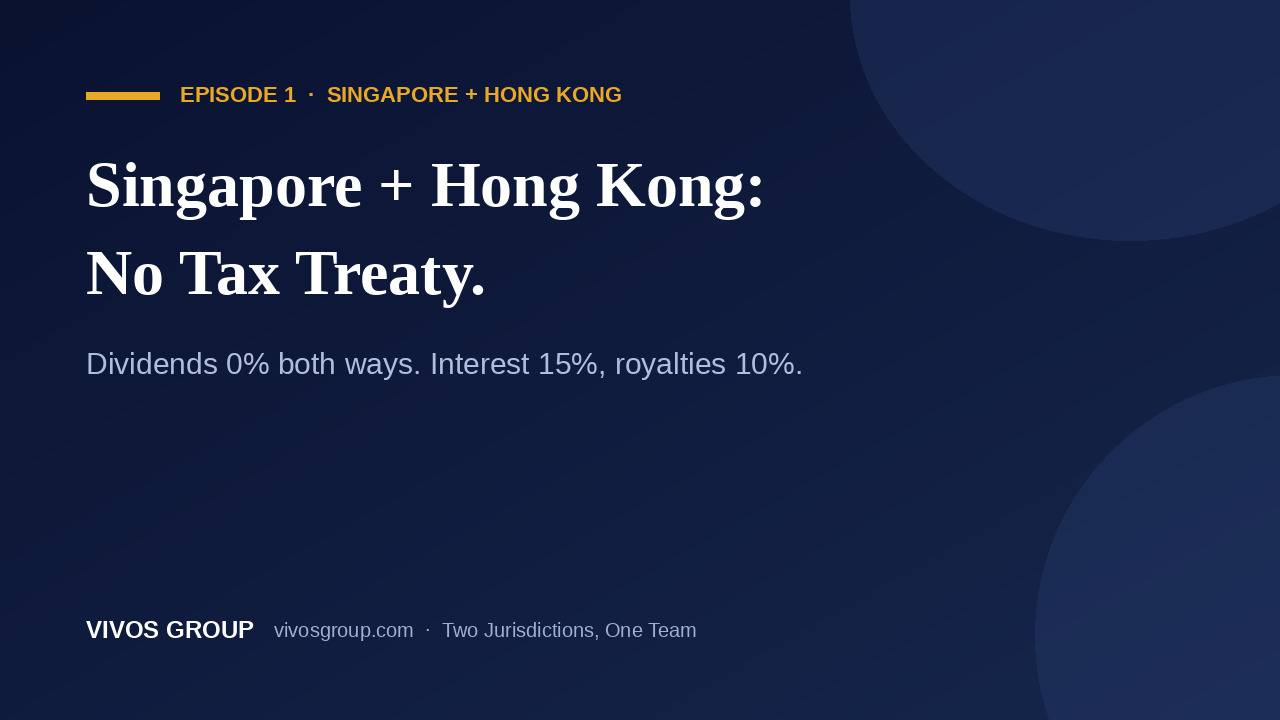
No. Singapore and Hong Kong have no comprehensive double tax agreement; the only agreement between them, signed on 28 November 2003, covers income from operating ships and aircraft. For dividends that barely matters, because neither side withholds tax on dividends. It matters for interest and royalties: a Singapore company paying a Hong Kong company withholds 15% on interest and 10% on royalties, with no treaty rate to claim.
| Payment | Singapore company pays Hong Kong company (SG → HK) | Hong Kong company pays Singapore company (HK → SG) | Treaty relief available? |
|---|---|---|---|
| Dividends | 0% | 0% | Not needed |
| Interest | 15% (final tax if the recipient has no business or permanent establishment in Singapore) | 0% | No |
| Royalties | 10% | 2.475% to 4.95% of the gross royalty; 8.25% to 16.5% if paid to an associate and the IP was previously owned in Hong Kong | No |
| Service fees (technical, management) | Nil if performed outside Singapore; prevailing corporate rate (17%), not a final tax, if performed in Singapore | Nil | No |
Sources: PwC Worldwide Tax Summaries, Singapore (last reviewed 2 July 2026); PwC, Hong Kong SAR (last reviewed 22 July 2026); IRAS (checked 5 October 2026).
Watch on YouTube: Singapore and Hong Kong Have No Tax Treaty. Does It Matter? (2026). Transcript below.
Most firms compare countries. VIVOS connects them. This guide is for founders running a company in Singapore and a company in Hong Kong at the same time, and it asks one question: what happens to money moving between the two?
Is there a double tax agreement between Singapore and Hong Kong?
Not a comprehensive one. Hong Kong’s Inland Revenue Department (IRD) lists the comprehensive double taxation agreements Hong Kong has concluded: Malaysia (in force 28 December 2012), the United Arab Emirates (signed 11 December 2014, in force 10 December 2015), the Chinese Mainland (1998, since revised) and India (2018) are on it; Singapore is not (IRD, checked 5 October 2026). The two signed a limited agreement on 28 November 2003 exempting income from operating ships and aircraft in international traffic (Singapore Ministry of Finance). For every other business, each side’s domestic rules apply.
Do dividends between a Singapore and a Hong Kong company suffer withholding tax?
No, in either direction. Neither Singapore nor Hong Kong withholds tax on dividends (PwC), so the missing treaty costs nothing at source. The receiving side still matters. A Singapore company can exempt a dividend from its Hong Kong subsidiary under section 13(8) of the Income Tax Act if the income was subject to tax in Hong Kong, Hong Kong’s headline rate is at least 15% (it is 16.5%), and IRAS is satisfied the exemption is beneficial. A Hong Kong company receiving a dividend from Singapore falls under Hong Kong’s FSIE regime, below.
Where does the missing treaty actually cost money?
In everything that is not a dividend. A Singapore company paying interest to a Hong Kong company withholds 15%; on royalties, 10%. For a recipient with no business or permanent establishment in Singapore that is a final tax, with no treaty rate to claim. S$100,000 of intercompany interest means S$15,000 goes to IRAS first; S$100,000 of royalties, S$10,000. The payer files and pays by the 15th of the second month after the date of payment (IRAS).
Service fees depend on where the work is done. Fees for services a non-resident company renders in Singapore are taxed at the prevailing corporate rate (17%), not as a final tax; services rendered wholly outside Singapore are not subject to withholding (IRAS).
Going the other way, Hong Kong does not withhold on dividends or interest. Royalties paid to a non-resident are taxed on a deemed 30% profit, so 2.475% to 4.95% of the payment, or 8.25% to 16.5% if paid to an associate and the IP was previously owned in Hong Kong (PwC Hong Kong). HK$1,000,000 of royalties at 4.95% costs HK$49,500.
What does Hong Kong’s FSIE regime mean for a two-company group?
It decides whether money arriving in Hong Kong stays tax-free. Since 1 January 2023, Hong Kong’s foreign-sourced income exemption (FSIE) regime treats foreign dividends, interest, IP income and equity disposal gains received in Hong Kong by an MNE entity as taxable unless an exception is met, extended to all disposal gains from 1 January 2024 (IRD). An MNE group is any group with an entity or permanent establishment outside its ultimate parent’s jurisdiction, and the rules apply irrespective of revenue or asset size. A Hong Kong company that owns, or is owned by, a Singapore company is in scope. (The test rests on consolidated accounts under a parent entity; if you hold both companies personally, check whether they form a group at all.)
The income stays exempt only if the Hong Kong company meets an exception:
- Economic substance (dividends, interest, disposal gains): a pure equity-holding company must meet its Hong Kong registration and filing requirements and have adequate people and premises in Hong Kong to manage its shareholdings; other companies need adequate qualified employees and operating expenditure in Hong Kong.
- Participation (dividends, equity gains): at least 5% held for at least 12 months, and the income or underlying profits taxed at a rate of at least 15%. Singapore’s 17% headline rate qualifies where the profits were actually taxed.
- Nexus (IP income): the exempt share follows the company’s own qualifying R&D.
Interest can only use the substance route. A Hong Kong lender with no real people in Hong Kong could have 15% withheld in Singapore and the interest taxed again in Hong Kong, relieved only by Hong Kong’s unilateral credit, which is capped at the Hong Kong tax on that income (IRD).
Which company should hold, invoice, and employ?
Decide the flows before you sign anything:
- Which company holds the other? Dividends move at 0% either way, so the choice turns on the receiving side: section 13(8) in Singapore, or the participation or substance test in Hong Kong.
- What moves as fees? Interest and royalties from Singapore cost 15% and 10%. Funding a Singapore company with share capital rather than a loan turns the return into dividends, which carry no withholding.
- Which company really does the work? Related-party charges must be at arm’s length in both places: Singapore under section 34D of the Income Tax Act 1947 (IRAS), Hong Kong under Part 8AA of the Inland Revenue Ordinance (IRD DIPN 59). The company that invoices should be the one with the staff.
How VIVOS runs both ends
VIVOS has its own company on each side: VIVOS Corporate Services (HK) Ltd. in Hong Kong and VIVOS Pte. Ltd. in Singapore. One team sets up and maintains both companies, keeps both compliance calendars in step, and maps the intercompany flows before the first invoice. One team, two companies, one plan.
Part of the Two Jurisdictions, One Team series
This is episode 1 of Two Jurisdictions, One Team, for clients who need two jurisdictions working together. The two-jurisdiction structures hub collects every corridor. Next, on Thursday 8 October 2026: Singapore HQ, Malaysia Team. Local detail: what the Hong Kong company must get right and the Singapore withholding tax checklist.
Video transcript
Video transcript
Do Singapore and Hong Kong have a tax treaty? Most founders assume they do. They don’t. Hong Kong’s list of comprehensive tax treaties includes Malaysia, the UAE, mainland China and India, but not Singapore. The only agreement between the two, signed in 2003, covers shipping and airlines.
Does that really matter? For dividends, barely. Neither Singapore nor Hong Kong withholds tax on dividends, so profits can move between your two companies with nothing deducted at source.
Where it bites is everything else. A Singapore company paying interest to a Hong Kong company withholds fifteen percent. Royalties, ten percent. With no treaty, there is no reduced rate to claim.
And once you own companies in both places, Hong Kong treats you as a multinational group, whatever your size. Foreign dividends received in Hong Kong stay tax-free only if your company passes a substance or participation test.
So decide the flows before you sign anything: what moves as dividends, what moves as fees, and which company really does the work.
VIVOS runs both sides, with VIVOS Corporate Services in Hong Kong and VIVOS in Singapore. One team, two companies, one plan.
Presented by an AI-generated avatar and voice of Ray Tay, co-founder of VIVOS. Written and fact-checked by VIVOS; facts checked 5 October 2026. General information, not tax advice.
Frequently asked questions
Do Singapore and Hong Kong have a double tax agreement?
Not a comprehensive one. Their only agreement, signed on 28 November 2003, covers income from operating ships and aircraft. Singapore is not on Hong Kong’s IRD list of comprehensive agreements (checked 5 October 2026).
Is there withholding tax on dividends paid from Singapore to Hong Kong?
No. Neither Singapore nor Hong Kong withholds tax on dividends. In Hong Kong, the dividend stays exempt only if the recipient meets the FSIE economic substance or participation requirement.
What withholding tax applies to interest paid from Singapore to Hong Kong?
15%, a final tax where the Hong Kong company has no business or permanent establishment in Singapore. No treaty reduces it. It is due to IRAS by the 15th of the second month after the date of payment.
What withholding tax applies to royalties between Singapore and Hong Kong?
10% from Singapore to Hong Kong. From Hong Kong to Singapore, 2.475% to 4.95% of the gross royalty, or 8.25% to 16.5% if paid to an associate and the IP was previously owned in Hong Kong.
Does Hong Kong’s FSIE regime apply to small companies?
Yes. It applies to MNE entities irrespective of revenue or asset size. A Hong Kong company with a Singapore subsidiary or parent is part of an MNE group.
Are service fees paid from Singapore to Hong Kong subject to withholding tax?
Only for services rendered in Singapore, taxed at the prevailing corporate rate (17%) and not as a final tax. Services performed wholly outside Singapore are not subject to withholding.
How this guide was verified
- Hong Kong IRD, comprehensive double taxation agreements and FSIE: checked 5 October 2026.
- Singapore Ministry of Finance, shipping and aircraft agreement: 28 November 2003.
- PwC Worldwide Tax Summaries, withholding taxes: Singapore (last reviewed 2 July 2026), Hong Kong SAR (last reviewed 22 July 2026).
- IRAS, foreign income (section 13(8)), withholding tax due date and transfer pricing; IRD DIPN 59: checked 5 October 2026.
Related services and insights
- Company incorporation in Hong Kong · Corporate secretarial and compliance · Business advisory
- Holding companies: Singapore, Hong Kong, UAE
- Corporate tax in four jurisdictions compared
- Expanding from Singapore
- Incorporation in four jurisdictions compared
- Videos: Singapore corporate tax for new companies · Singapore holding company for Indonesia · what a Singapore company costs a foreigner
Running companies in Singapore and Hong Kong?
Tell us which way the money moves and we will map both sides before you sign. Talk to our team or WhatsApp +65 9366 9399.
- VIVOS Pte. Ltd. (Singapore): UEN 202416468C · ACRA Registered Filing Agent FA20240323 · MOM EA Licence 24S2425
- VIVOS (M) Sdn. Bhd. (Malaysia): Registration No. 202501057568 (1658974-A)
- VIVOS Corporate Services (HK) Ltd. (Hong Kong): Business Registration No. 80545137
- VIVOS Corporate Services L.L.C. (UAE): Commercial Licence No. 1638200
Reviewed by Ray Tay, VIVOS.
General information, not tax advice. Your position depends on your facts, including residence, where work is performed and how the group is owned.