
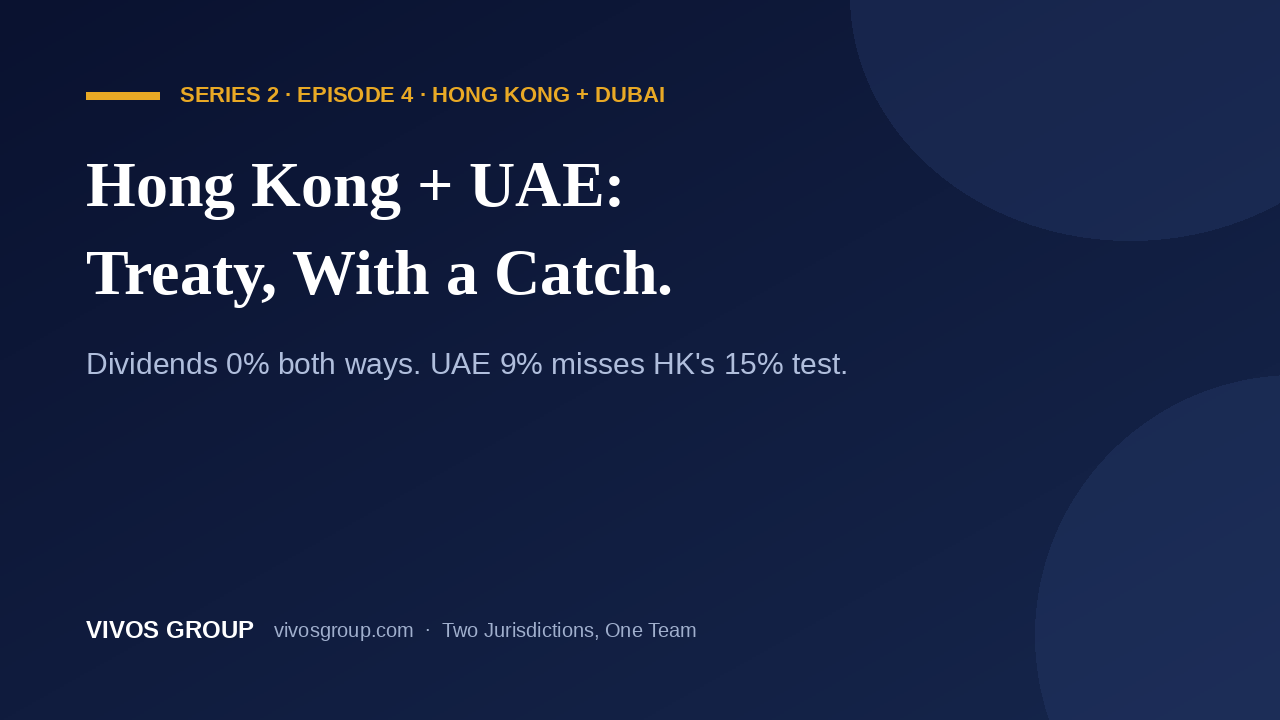
Insights · Two Jurisdictions, One Team · Episode 4: Hong Kong + Dubai
Is There a Hong Kong UAE Tax Treaty? Yes, With One Catch (2026)
Yes. Hong Kong and the United Arab Emirates (UAE) have had a comprehensive double tax agreement since 10 December 2015. In 2026 neither side withholds tax on dividends; the treaty caps interest and royalties at 5%. But the UAE’s 9% headline rate fails Hong Kong’s 15% participation test, so Dubai dividends are tax-free in Hong Kong only with economic substance.
Key facts: the Hong Kong UAE tax treaty (as of October 2026)
- The Hong Kong-UAE comprehensive double taxation agreement was signed on 11 December 2014, entered into force on 10 December 2015 and has effect in Hong Kong from the 2016/2017 year of assessment (Hong Kong IRD, DTA list).
- Dividends paid between a Hong Kong company and a UAE company carry 0% withholding tax in both directions as of October 2026 (Hong Kong-UAE DTA, Protocol para III; UAE Corporate Tax Law, Art 45).
- The treaty caps tax at source on interest and royalties at 5% of the gross amount where the beneficial owner is resident in the other territory (Hong Kong-UAE DTA, Arts 11(2) and 12(2)).
- Hong Kong’s FSIE regime applies to a Hong Kong company in a multinational group, such as one that owns a Dubai company, irrespective of its revenue or asset size (Hong Kong IRD, FSIE page).
- Hong Kong’s participation exemption needs at least 5% held for 12 months and a headline rate abroad of 15% or more; the UAE’s headline corporate tax rate is 9%, so a Dubai dividend gets a tax credit, not an exemption (IRD FSIE page; UAE Corporate Tax Law, Art 3).
- UAE corporate tax is 0% on taxable income up to AED 375,000 and 9% above, as of October 2026 (Federal Decree-Law No. 47 of 2022, Art 3; Cabinet Resolution No. 116 of 2022).
| Payment | Dubai company pays Hong Kong company (UAE → HK) | Hong Kong company pays Dubai company (HK → UAE) | Treaty cap on tax at source |
|---|---|---|---|
| Dividends | 0% (the UAE’s withholding tax rate is 0%) | 0% (no tax on dividends beyond the tax on profits) | 5%; 0% on dividends paid to the other government |
| Interest | 0% (the UAE’s withholding tax rate is 0%) | No more than 5% | 5% of the gross amount |
| Royalties | 0% (the UAE’s withholding tax rate is 0%) | No more than 5%; Hong Kong can tax royalties paid to non-residents | 5% of the gross amount |
Sources: Hong Kong IRD, Hong Kong-UAE agreement (Articles 10 to 12, Protocol para III); UAE Corporate Tax Law, Article 45; checked 6 October 2026. Royalties paid to non-residents: Hong Kong IRD, Profits Tax (section 15(1)(b)), checked 7 October 2026.
Watch on YouTube (79 seconds): Is There a Hong Kong UAE Tax Treaty? Yes, With One Catch (2026). Transcript below.
Most firms compare countries. VIVOS connects them. This guide is for founders with a Hong Kong company that owns a Dubai company, and covers what happens to money moving between the two. Hong Kong’s group rules bite where one company owns the other; if you hold the two companies personally, side by side, check first whether they form a group at all.
What does the Hong Kong UAE tax treaty cover?
The Hong Kong UAE tax treaty is a comprehensive double tax agreement (DTA): a treaty that decides which side may tax cross-border income such as dividends, interest and royalties, and caps the tax charged at source. Hong Kong’s Inland Revenue Department (IRD) lists it as signed on 11 December 2014, in force since 10 December 2015 and effective in Hong Kong from the year of assessment 2016/2017 (IRD, checked 6 October 2026).
The multilateral instrument (MLI), the OECD convention that updates existing treaties against abuse, also applies. The IRD’s synthesised text includes its principal purpose test, which can deny a treaty benefit where obtaining it was one of the principal purposes of an arrangement (checked 7 October 2026). The treaty is the mirror image of Episode 1, Singapore and Hong Kong: Singapore is not on the IRD’s list, so Singapore and Hong Kong have no comprehensive tax treaty and deal with each other under domestic rules alone.
Do dividends between a Hong Kong and a Dubai company suffer withholding tax?
No, in either direction, as of October 2026. Withholding tax is tax the paying company deducts at source before the money leaves; the UAE’s rate is 0% (Corporate Tax Law, Article 45), and the treaty’s protocol records that under the current law of both sides “there is no tax chargeable on dividends in addition to the tax chargeable on the profits or income of a company” (Protocol, para III, IRD synthesised text).
The treaty itself caps tax at source at 5% on dividends, interest and royalties: “the tax so charged shall not exceed five per cent of the gross amount” (Articles 11(2) and 12(2); Article 10(2) for dividends). That cap matters most for royalties paid out of Hong Kong. Hong Kong charges profits tax on sums a non-resident receives for the use of intellectual property in Hong Kong, and the Hong Kong payer must deduct the tax (IRD, Profits Tax, section 15(1)(b), checked 7 October 2026). So do not assume 0% on royalties.
When do the treaty’s 5% caps apply?
The 5% caps apply where the beneficial owner of the interest or royalties is resident in the other territory, and not where the income is effectively connected with a permanent establishment (a fixed place of business) that the recipient has in the paying territory (Articles 11(2), 11(5), 12(2) and 12(4), checked 7 October 2026).
The treaty text does not mention a certificate of residence; it leaves the “mode of application” of the limits to the two tax authorities. In practice, proof of residence is generally expected. For a Hong Kong company, that is the IRD’s Certificate of Resident Status, which the IRD issues to Hong Kong residents claiming treaty benefits but which does not by itself guarantee them (IRD, checked 7 October 2026). A Dubai company claiming the Hong Kong cap should generally expect to evidence its UAE residence in the same way.
Why does Hong Kong treat a two-company group as a multinational?
Because Hong Kong’s foreign-sourced income exemption (FSIE) regime, which taxes certain foreign dividends, interest and gains received in Hong Kong by members of multinational groups unless an exception applies, covers an MNE entity “irrespective of its revenue or asset size” (IRD, checked 6 October 2026).
An MNE (multinational enterprise) group is one with at least one entity outside the ultimate parent’s jurisdiction, so a Hong Kong company that owns a Dubai company is an MNE entity. The test applies where one company owns the other. Two companies held personally, side by side, may not form a group at all.
Which FSIE test can a Dubai dividend pass?
Only the economic substance test gives a full exemption. The participation test fails on its 15% condition, because the UAE’s headline rate is 9%.
| Route | What the Hong Kong company needs | Minimum tax rate abroad | Dubai dividend (UAE headline rate 9%) |
|---|---|---|---|
| Economic substance | As a pure equity-holding company: registration and filing requirements met; adequate people and premises in Hong Kong (outsourcing allowed with conditions) | None | Exempt if met |
| Participation | At least 5% held for at least 12 months before the dividend accrues | 15% or more on the dividend or underlying profits (generally the headline rate) | Fails: 9% is below 15%, so relief becomes a credit for UAE tax |
The participation exemption is the route for shareholdings. Its switch-over rule (the subject-to-tax condition) requires the dividend or the underlying profits to be taxed at an applicable rate of at least 15%, and the IRD says the applicable rate generally “refers to the headline rate (i.e. the highest corporate tax rate)” of the jurisdiction (checked 7 October 2026). The headline tax rate is therefore the top statutory corporate rate, not the rate a company actually paid.
The UAE’s headline rate is 9% (Corporate Tax Law, Article 3), so relief is “switched over from full exemption to tax credit”. The dividend is taxed in Hong Kong when received, with a credit for UAE tax on it and on the underlying profits; the underlying credit needs at least 10% held when the dividend is distributed (IRD, checked 7 October 2026). Economic substance has no rate condition.
How much tax does a Dubai dividend bear in practice?
With substance in Hong Kong, only the UAE corporate tax. Relying on participation, Hong Kong profits tax on the dividend, less a credit for that UAE tax.
A worked example: a Hong Kong company owns 100% of a Dubai company with AED 1,000,000 of taxable income. UAE corporate tax is 0% on the first AED 375,000 and 9% on the remaining AED 625,000: AED 56,250, about 5.6% (Cabinet Resolution No. 116 of 2022). The dividend leaves Dubai with nothing withheld.
- With substance in Hong Kong: exempt. The AED 56,250 of UAE tax is the only tax.
- Relying on participation: chargeable in Hong Kong when received, with a credit of at most AED 56,250.
- Qualifying free zone person paying 0%: a qualifying free zone person (QFZP) is a UAE free zone company that meets the conditions for 0% on qualifying income. It leaves little or nothing to credit, so substance decides almost everything.
What does economic substance look like for a Hong Kong holding company?
For a pure equity-holding company: meet the registration and filing requirements, and have adequate people and premises in Hong Kong to hold and manage the shareholdings, with outsourcing allowed on conditions (IRD, checked 6 October 2026).
The filings are concrete. The annual return, the yearly filing that confirms the company’s officers and shareholders, is due within 42 days after each incorporation anniversary (Companies Registry). The profits tax return is issued every April (1 April 2026 for 2025/26) and is generally due within one month, later with a tax representative (HKSAR Government). People and premises need evidence: minutes, agreements, a lease. The detail, including the IRD’s outsourcing conditions, is in the Hong Kong parent’s FSIE substance checklist.
How is the Hong Kong UAE corridor different from Singapore and Hong Kong?
The UAE corridor has a treaty and the Singapore corridor does not, but the treaty does not decide the FSIE result: the partner’s headline rate does.
| Point | Singapore ↔ Hong Kong (Episode 1) | Hong Kong ↔ UAE (Episode 4) |
|---|---|---|
| Comprehensive tax treaty | No | Yes, in force since 10 December 2015 |
| Dividend withholding | 0% both ways | 0% both ways |
| Interest and royalties at source | No treaty rate to claim | Capped at 5% |
| Partner’s headline rate vs the 15% participation test | Singapore 17%: above 15% | UAE 9%: below 15% |
A treaty settles withholding. It does not settle how a dividend is taxed once it lands in Hong Kong.
What should you check before the first Dubai dividend?
Five things, in this order.
- Confirm the group: does one company own the other, or are both held personally, side by side?
- Plan for substance: with the UAE at 9%, participation gives only a credit.
- Evidence it: people, premises and on-time filings in Hong Kong.
- Run the Dubai side: corporate tax return within 9 months after the tax period ends; free zone status only with UAE substance (the Dubai subsidiary’s UAE corporate tax checklist).
- Paper the treaty claims: proof of residence for the 5% caps, such as the IRD’s Certificate of Resident Status for a Hong Kong company.
How does VIVOS run both ends?
VIVOS has its own licensed company on each side: VIVOS Corporate Services (HK) Ltd. in Hong Kong and VIVOS Corporate Services L.L.C. in Dubai. One team sets up and maintains both companies, keeps both compliance calendars in step, and maps the dividend, interest and royalty flows before the first payment. One team, two companies, one plan.
Part of the Two Jurisdictions, One Team series
This is episode 4 of Two Jurisdictions, One Team. Episode 1 covered why Singapore and Hong Kong have no tax treaty and Episode 2 a Singapore HQ with a Malaysia team; Episode 3 (Singapore + Dubai) and every corridor are on the two-jurisdiction structures hub. Next, on Thursday 15 October 2026: Companies in two countries, the compliance calendar. Local detail: the Hong Kong parent’s FSIE substance checklist and the Dubai subsidiary’s UAE corporate tax checklist.
Video transcript
Video transcript (79 seconds)
Is there a tax treaty between Hong Kong and the UAE? Yes. A full double tax agreement was signed in December 2014 and has been in force since December 2015. Singapore and Hong Kong have no full treaty.
Dividends flow cleanly: neither Hong Kong nor the UAE withholds tax on them. The treaty caps withholding on interest and royalties at five percent.
The catch comes when a Dubai company pays dividends up to Hong Kong. Where one company owns the other, Hong Kong treats them as a multinational group, whatever their size.
Those dividends are then tax-free only if the Hong Kong company passes one of two tests. Economic substance: for a pure holding company, adequate people and premises in Hong Kong. Or participation: at least five percent, held for twelve months, with the profits taxed abroad at a headline rate of fifteen percent or more.
The UAE’s headline rate is nine percent, so the participation route gives only a credit for UAE tax, not an exemption. Substance is the test to plan for.
VIVOS runs both ends, with our offices in Hong Kong and in Dubai. One team, two companies, one plan.
Presented by an AI-generated avatar and voice of Ray Tay, co-founder of VIVOS. Content written and fact-checked by VIVOS; facts checked 6 October 2026. General information, not tax advice.
Frequently asked questions
Is there a tax treaty between Hong Kong and the UAE in 2026?
Yes. Hong Kong and the United Arab Emirates signed a comprehensive double taxation agreement on 11 December 2014, and it has been in force since 10 December 2015, with effect in Hong Kong from the 2016/2017 year of assessment (Hong Kong IRD, checked 6 October 2026). Singapore and Hong Kong, by contrast, have no comprehensive tax treaty.
Is there withholding tax on dividends between Hong Kong and the UAE?
No, in either direction. The UAE’s withholding tax rate is 0% under Article 45 of its Corporate Tax Law, and the treaty’s protocol records that neither Hong Kong nor the UAE charges tax on dividends beyond the tax on company profits. How a Dubai dividend is taxed once it is received in Hong Kong is a separate question under Hong Kong’s FSIE rules.
What withholding tax rate does the Hong Kong-UAE treaty allow on interest and royalties?
At most 5% of the gross amount, under Articles 11(2) and 12(2), where the beneficial owner is resident in the other territory. The cap matters most for royalties paid out of Hong Kong, because Hong Kong can tax royalties paid to non-residents, while the UAE withholds 0% anyway. Proof of residence, such as an IRD Certificate of Resident Status, is generally expected.
Does Hong Kong’s FSIE regime apply to a small Hong Kong company that owns a Dubai company?
Yes. Hong Kong’s foreign-sourced income exemption (FSIE) regime applies to an MNE entity irrespective of its revenue or asset size, and a Hong Kong company that owns a Dubai company is part of a multinational group. The test applies where one company owns the other; two companies held personally, side by side, may not form a group at all.
Can a Dubai dividend be tax-free in Hong Kong under the participation exemption?
Not as an exemption. Participation needs at least 5% held for 12 months and a tax rate abroad, generally the headline rate, of 15% or more. The UAE’s headline corporate tax rate is 9%, so relief switches from exemption to a tax credit for UAE tax on the dividend and the underlying profits, with the underlying credit needing a holding of at least 10%.
What economic substance does a Hong Kong holding company need for Dubai dividends?
A pure equity-holding company must meet its Hong Kong registration and filing requirements, such as the annual return within 42 days after each incorporation anniversary, and have adequate people and premises in Hong Kong to hold and manage its shareholdings. Outsourcing is allowed with conditions. Unlike participation, the substance route has no 15% minimum tax rate abroad.
How much UAE corporate tax does a Dubai subsidiary pay before it pays a dividend?
UAE corporate tax is 0% on taxable income up to AED 375,000 and 9% above (Cabinet Resolution No. 116 of 2022). On AED 1,000,000 of taxable income that is AED 56,250, about 5.6%. A qualifying free zone person can pay 0% on qualifying income if it meets the conditions, which leaves little or nothing for its Hong Kong parent to credit.
Sources: how this guide was verified
- Hong Kong IRD: Comprehensive Double Taxation Agreements concluded (treaty dates, MLI). Checked 6 October 2026.
- Hong Kong IRD: Hong Kong-UAE double taxation agreement, synthesised text with the MLI (Articles 10 to 12 and Protocol para III, checked 6 October 2026; beneficial owner, permanent establishment and mode-of-application wording and the principal purpose test, checked 7 October 2026).
- Hong Kong IRD: Foreign-sourced income exemption (FSIE) regime (scope, substance, participation, switch-over, checked 6 October 2026; headline-rate wording and the 10% underlying credit, checked 7 October 2026).
- Hong Kong IRD: Profits Tax (sums received by non-residents, section 15(1)(b)). Checked 7 October 2026.
- Hong Kong IRD: Certificate of Resident Status. Checked 7 October 2026.
- Hong Kong Companies Registry: annual return (local private company). Checked 6 October 2026.
- HKSAR Government: profits tax returns issued (1 April 2026). Checked 6 October 2026.
- UAE: Corporate Tax Law, Federal Decree-Law No. 47 of 2022 (consolidated), Articles 3, 18, 45 and 53. Checked 6 October 2026.
- UAE: Cabinet Resolution No. 116 of 2022 (AED 375,000 threshold). Checked 6 October 2026.
- UAE Ministry of Finance: Corporate Tax in the UAE. Checked 6 October 2026.
- UAE FTA: Corporate Tax (return deadline). Checked 6 October 2026.
Related services and insights
- Company incorporation in Hong Kong · Company setup in the UAE, mainland or free zone · Corporate secretarial and compliance · Business advisory
- Hong Kong’s FSIE regime in 2026, in full
- UAE free zone or mainland in 2026
- Holding companies: Singapore, Hong Kong, UAE
- Corporate tax in four jurisdictions compared
- Videos: Episode 1, Singapore and Hong Kong have no tax treaty · Episode 2, Singapore HQ, Malaysia team · Singapore holding company for Indonesia
Running companies in Hong Kong and Dubai?
Tell us which way the money moves and we will map both sides before the first dividend. Talk to our team or WhatsApp +65 8827 7870.
- VIVOS Corporate Services (HK) Ltd. (Hong Kong): Business Registration No. 80545137 · NCB Innovation Centre, Lai Chi Kok Road, Cheung Sha Wan
- VIVOS Corporate Services L.L.C. (UAE): Commercial Licence No. 1638200 · Unit 415, Churchill Executive Tower, Business Bay, Dubai · +971 56 408 7384
VIVOS Group is the group of four licensed companies, in Singapore, Malaysia, Hong Kong and the UAE, plus teams in China and India; every corridor between them is on the two-jurisdiction structures hub.
Published 14 October 2026 · Last reviewed 6 October 2026 · Reviewed by Ray Tay, VIVOS.
General information, not tax advice. Your position depends on your facts, including how the group is owned and where its people work.