
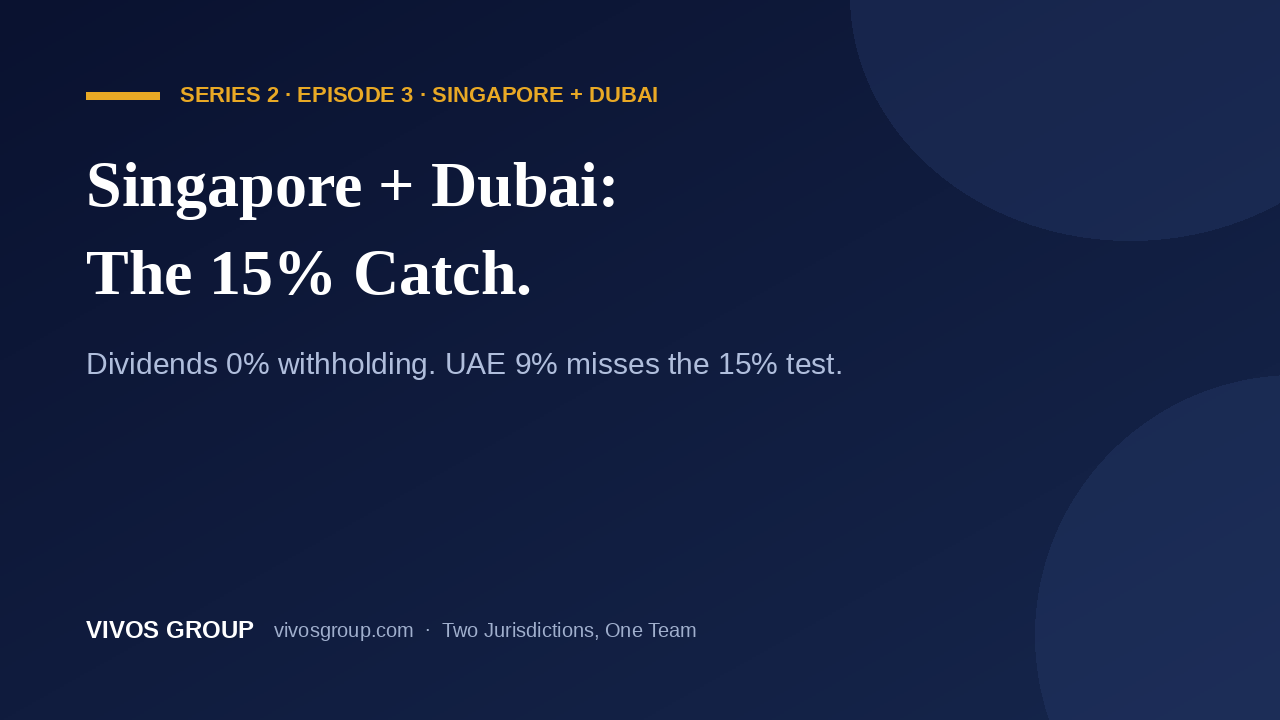
Insights · Two Jurisdictions, One Team · Episode 3: Singapore + Dubai
Singapore Company, Dubai Company: Are the Dividends Tax-Free? (2026)
Not in Singapore. In 2026, dividends a Dubai company pays its Singapore parent leave the United Arab Emirates (UAE) with 0% withholding under the Singapore-UAE treaty, but Singapore taxes them at 17% when received: the section 13(8) exemption needs a headline tax rate of at least 15% abroad, and the UAE’s is 9%, so Dubai dividends fail that test. Relief is a credit for UAE tax paid, which may be small. The rest of a Singapore Dubai company structure is simpler: interest is 0% both ways, Singapore tax on royalties paid to Dubai is capped at 5%, and Dubai corporate tax is 0% on the first AED 375,000 of taxable income and 9% above.
Key facts (as of October 2026)
- Under the Singapore-UAE double tax agreement, dividends and interest paid to a resident of the other country “shall be taxable only in that other State”, so 0% is withheld on either, both ways (Singapore-UAE DTA Arts 10(1) and 11(1), as replaced by the Second Protocol from 1 January 2017).
- Singapore tax on royalties paid to a UAE resident that is the beneficial owner is capped at 5% of the gross amount (Singapore-UAE DTA Art 12(2)).
- UAE corporate tax is 0% on taxable income up to AED 375,000 and 9% above, as of October 2026 (Federal Decree-Law No. 47 of 2022, Art 3(1); Cabinet Resolution No. 116 of 2022).
- A UAE qualifying free zone person pays 0% on qualifying income and 9% on other income, and must keep adequate substance in the UAE (UAE Corporate Tax Law Arts 3(2) and 18(1)).
- Singapore’s section 13(8) exemption for foreign dividends needs a headline tax rate of at least 15% in the source country; the UAE’s is 9%, so on IRAS’s published rule Dubai dividends received in Singapore are taxable at 17%, as of October 2026 (IRAS e-Tax Guide on foreign-sourced income, 5th edition, paras 2.1 and 8.1 to 8.4).
- Singapore credits UAE tax on a Dubai dividend, including UAE tax on the paying company’s profits (Singapore-UAE DTA Art 23(3)); the UAE’s 15% top-up tax does not count toward the headline rate (IRAS section 13(12) e-Tax Guide, para 8.2).
| Payment | Singapore company pays Dubai company (SG → UAE) | Dubai company pays Singapore company (UAE → SG) | Treaty rule |
|---|---|---|---|
| Dividends | 0% (Singapore has no dividend withholding tax) | 0% (the UAE’s withholding tax rate is 0%) | Art 10(1): taxable only where the recipient is resident |
| Interest | 0% under the treaty | 0% | Art 11(1): taxable only where the recipient is resident |
| Royalties | Capped at 5% of the gross amount (beneficial owner) | 0% (the UAE’s withholding tax rate is 0%) | Art 12(2): tax at source capped at 5% |
Sources: IRAS, Singapore-UAE treaty text with the Second Protocol; UAE Corporate Tax Law, Art 45(1). Checked 6 October 2026. Treaty rates assume a resident recipient with no permanent establishment in the paying country (see below).
Watch on YouTube: Singapore Company, Dubai Company: Are the Dividends Tax-Free? (2026) (84 seconds). Transcript below.
Most firms compare countries. VIVOS connects them. This guide is for founders running a company in Singapore and a company in Dubai, usually with one owning the other.
Can a Singapore company own a Dubai company?
Yes. What then matters is how money moving between the two is taxed, and Singapore and the UAE have a comprehensive double tax agreement (DTA): a treaty that decides which country may tax income flowing between residents of the two countries and caps tax at source. Its Second Protocol, signed on 31 October 2014 and in force since 16 March 2016, rewrote the dividend and interest articles with effect from 1 January 2017 (Singapore Ministry of Finance; IRAS treaty text).
What withholding tax applies in a Singapore Dubai company structure?
None on dividends or interest, and at most 5% on royalties paid from Singapore. Withholding tax is tax the paying country deducts at source from a payment to a non-resident. Under Article 10(1), as replaced, dividends paid by a company resident in one country to a resident of the other “shall be taxable only in that other State”. Article 11(1) says the same for interest. Domestic law agrees for dividends: Singapore’s one-tier system means no dividend withholding tax (IRAS), and the UAE’s withholding tax rate is 0% (Corporate Tax Law Art 45(1)).
Royalties are the exception: Article 12(2) caps tax at source at 5% of the gross amount where the recipient is the beneficial owner, so no more than S$5,000 on a S$100,000 royalty from Singapore.
What conditions do the treaty rates carry?
Four, all in the IRAS treaty text (checked 7 October 2026):
- Residence. The recipient must be a resident of Singapore or the UAE, meaning resident there under that country’s tax laws (Art 4(1)).
- Beneficial ownership, for royalties. The 5% cap applies only where the recipient is the beneficial owner of the royalties (Art 12(2)); the treaty does not define the term.
- No permanent establishment link. None of the three rules applies where the payment is effectively connected with a permanent establishment the recipient has in the paying country; a permanent establishment is, broadly, a fixed place of business through which a company carries on business (Art 5(1); Arts 10(3) and 11(3) as renumbered by the Second Protocol; Art 12(5)).
- Principal purpose test. Article 27A, added through the Multilateral Instrument (MLI), denies a treaty benefit where obtaining it was one of the principal purposes of an arrangement.
The treaty itself sets no paperwork. Keeping a current UAE tax residency certificate for the Dubai company on file is a sensible precaution.
How much corporate tax does the Dubai company pay?
0% on taxable income up to AED 375,000 and 9% above (Corporate Tax Law Art 3(1); Cabinet Resolution No. 116 of 2022). On AED 1,000,000 of taxable income: 9% of AED 625,000, or AED 56,250, an effective rate of about 5.6%.
A qualifying free zone person (QFZP), a free zone company that meets the conditions in Article 18 of the Corporate Tax Law, pays 0% on qualifying income and 9% on other income (Art 3(2) and Art 18(1); UAE Ministry of Finance). The conditions: adequate substance in the UAE, qualifying income, no election to be taxed at the regular rates, transfer pricing compliance and any conditions the Minister sets. Treat substance as a day-one design question, not a filing detail.
Are Dubai dividends tax-free when they reach Singapore?
No, not under Singapore’s main exemption. This is what most founders miss. Singapore taxes foreign-sourced dividends when they are received in Singapore, at 17%, unless exempt (IRAS e-Tax Guide, Tax Exemption for Foreign-Sourced Income, 5th edition, 30 January 2026). The main exemption, section 13(8) of the Income Tax Act, needs all three of:
- Subject to tax: the income was taxed in the source country;
- Headline tax rate of at least 15%: the headline tax rate is the source country’s highest corporate income tax rate in the year the dividend is received in Singapore;
- Beneficial: the exemption benefits the Singapore company.
The UAE’s highest corporate rate is 9%. On the plain rule, UAE dividends received in Singapore fail the second condition, even where the Dubai company actually paid 9%. Hence the video’s line: Dubai dividends fail that test.
Two points of care. IRAS publishes the rule, not a country list; we found no IRAS publication naming the UAE, so the conclusion is VIVOS’s application of the published rule (checked 6 October 2026). And the test uses the country’s headline rate, not what a company paid: a Dubai company at an effective 5.6% and one at 0% are in the same position.
Does the UAE’s 15% top-up tax change the answer?
No. The UAE’s Domestic Minimum Top-up Tax (DMTT) is a 15% minimum tax that applies only to groups with revenue of EUR 750 million or more (UAE Ministry of Finance). Even where it applies, IRAS’s section 13(12) e-Tax Guide (12th edition, 7 January 2026, para 8.2) says a qualified domestic minimum top-up tax “should not be taken into consideration” when determining the headline rate, although it counts as tax paid (para 8.1).
What relief is left for Dubai dividends?
Three routes: a treaty credit, a section 13(12) application before the money arrives, or leaving the dividend outside Singapore.
- Treaty credit. Under Article 23(3), Singapore credits UAE tax, including UAE tax on the profits behind the dividend. As the video says, it may be small: a company paying 0% on its first AED 375,000, or a qualifying free zone person, leaves little to credit, so a dividend received in Singapore could bear close to the full 17%.
- Section 13(12). Section 13(12) lets the Ministry of Finance (MOF) exempt foreign income that section 13(8) does not cover. Apply before the money is received in Singapore; approval is case by case, where the remittance brings economic benefits to Singapore (paras 7 and 9.2). The guide’s specified scenarios do not help here: the ones that deem the 15% condition met need a treaty clause, and the Singapore-UAE treaty has none.
- Timing. Nothing is taxed in Singapore while the dividend stays outside Singapore.
How much Singapore tax could a Dubai dividend bear? A worked example
Anything up to close to the full 17%, depending on how much UAE tax sits behind it. Take a Singapore company that owns a Dubai mainland company with AED 1,000,000 of taxable income.
- Dubai: UAE corporate tax of AED 56,250 (0% on AED 375,000, 9% on AED 625,000).
- Dividend declared: no UAE withholding; under the treaty, taxable only in Singapore.
- Held offshore: no Singapore tax yet.
- Received in Singapore: no section 13(8) exemption. Taxable at 17%, with a credit that takes into account the AED 56,250. At an effective 5.6%, that covers part of the Singapore tax, not all of it.
- As a qualifying free zone person at 0%: almost nothing to credit, so close to the full 17%.
The final Singapore figure depends on the amount remitted, the exchange rate and how the credit is computed on your facts. Run it before the money moves.
What should you decide before moving money from Dubai to Singapore?
Three things, as the video says: where profits are taxed, when they come home, and which relief applies. Two more keep the structure clean.
- Where are profits taxed? Dubai at 0% then 9%, or a free zone at 0% on qualifying income, with the substance to back it.
- When do they come home? Singapore taxes dividends when received.
- Which relief applies? Treaty credit, a section 13(12) application before receipt, or neither. Not section 13(8).
- What moves as interest or royalties? 0% on interest and at most 5% on royalties under the treaty, for a UAE-resident recipient with no permanent establishment in Singapore; keep evidence of the Dubai company’s UAE tax residence on file.
- Is the Dubai calendar set? Corporate tax return within nine months after the tax period ends: 30 September 2026 for a year ended 31 December 2025.
How does VIVOS run both ends?
With its own licensed company on each side: VIVOS Pte. Ltd. in Singapore and VIVOS Corporate Services L.L.C. in Dubai. One team sets up and maintains both companies, keeps the Singapore and UAE filing calendars in step, and maps where profits are taxed and when they come home before the first dividend is declared. One team, two companies, one plan.
Part of the Two Jurisdictions, One Team series
This is episode 3 of Two Jurisdictions, One Team, after the Singapore and Hong Kong tax treaty guide (episode 1) and Singapore HQ, Malaysia team (episode 2). The two-jurisdiction structures hub collects every corridor. Next, on Wednesday 14 October 2026: Hong Kong + Dubai. Local detail for this corridor: what a Dubai company with a Singapore parent must get right (the UAE side, on VIVOS UAE) and the dividend tax checklist for a Singapore company with a Dubai subsidiary (the Singapore side, on vivos.com.sg).
Video transcript
Video transcript
Can a Singapore company own a Dubai company, and how does money move between them? Yes, and the Singapore-UAE tax treaty keeps it simple: dividends and interest are taxed only where the receiving company is resident.
Nothing is withheld on dividends or interest. Singapore has no dividend withholding tax, the UAE’s withholding rate is zero, and royalties from Singapore are capped at five percent.
In Dubai, corporate tax is zero on the first three hundred and seventy-five thousand dirhams of taxable income, then nine percent. Free zone companies may pay zero on qualifying income, but only with real substance.
Here is what most founders miss. Singapore taxes foreign dividends when they are received in Singapore, unless exempt, and the main exemption needs a headline tax rate of at least fifteen percent abroad. The UAE’s is nine percent, so Dubai dividends fail that test. Relief is then a credit for UAE tax paid, which may be small.
So plan before you move money: where profits are taxed, when they come home, and which relief applies.
VIVOS runs both ends, with VIVOS in Singapore and VIVOS Corporate Services in Dubai. One team, two companies, one plan.
Presented by an AI-generated avatar and voice of Ray Tay, co-founder of VIVOS. Written and fact-checked by VIVOS; facts checked 6 October 2026. General information, not tax advice.
Frequently asked questions
Can a Singapore company own a Dubai company?
Yes. A Singapore company can own a Dubai company, and the Singapore-UAE tax treaty sets how payments between the two are taxed: dividends and interest are taxable only where the receiving company is resident, so 0% is withheld on either, and Singapore tax on royalties paid to the Dubai company is capped at 5% of the gross amount.
Is there withholding tax on dividends and interest between Singapore and the UAE?
No. Singapore has no dividend withholding tax under its one-tier system, the UAE’s withholding tax rate is 0%, and since 1 January 2017 the Singapore-UAE treaty, as amended by its Second Protocol, makes dividends and interest paid to a resident of the other country taxable only in that country. Royalties are the exception: Singapore tax on royalties paid to the UAE is capped at 5%.
What corporate tax does a Dubai company pay in 2026?
UAE corporate tax is 0% on taxable income up to AED 375,000 and 9% above, so AED 1,000,000 of taxable income bears AED 56,250. A qualifying free zone person pays 0% on qualifying income and 9% on other income, but only while it meets the conditions, including adequate substance in the UAE, no election to be taxed at the regular rates and transfer pricing compliance.
Are dividends from a Dubai company tax-exempt in Singapore?
Not under section 13(8) on IRAS’s published rule. The exemption needs a headline tax rate of at least 15% in the source country, and the UAE’s highest corporate rate is 9%, so Dubai dividends fail that test. IRAS publishes the rule, not a country list. A dividend received in Singapore is taxed at 17%, with a credit for UAE tax.
Does the UAE’s 15% top-up tax help a Dubai dividend pass Singapore’s 15% test?
No. IRAS’s section 13(12) e-Tax Guide (12th edition, 7 January 2026, para 8.2) says a qualified domestic minimum top-up tax should not be taken into consideration when determining the headline rate, although it counts as tax paid. The UAE’s 15% Domestic Minimum Top-up Tax also applies only to groups with revenue of EUR 750 million or more.
How else can a Singapore company reduce tax on Dubai dividends?
Three routes remain. Claim the treaty credit under Article 23(3), which takes into account UAE tax on the profits of the paying company; apply to MOF under section 13(12) before the money is received in Singapore, which is decided case by case; or keep the dividend outside Singapore, where it is not taxed until received. General information, not tax advice.
What conditions apply to the Singapore-UAE treaty rates?
The recipient must be a resident of Singapore or the UAE under that country’s tax laws (Article 4(1)), and the 5% royalty cap needs it to be the beneficial owner (Article 12(2)). The rules do not apply to income connected with a permanent establishment in the paying country, and Article 27A, added through the MLI, denies benefits where obtaining them was one of the principal purposes of an arrangement.
Sources and how this guide was verified
- IRAS, Singapore-UAE DTA consolidated text with the Second Protocol and MLI changes (Arts 4, 5, 10, 11, 12, 23(3), 27A). Checked 6 October 2026; residence, permanent establishment and Article 27A wording re-checked 7 October 2026.
- Singapore Ministry of Finance, Second Protocol to the Singapore-UAE agreement enters into force (16 March 2016). Checked 6 October 2026.
- IRAS e-Tax Guide, Tax Exemption for Foreign-Sourced Income (5th edition, 30 January 2026), paras 2.1, 4.2, 5.3, 7.1 and 8.1 to 8.4. Checked 6 October 2026.
- IRAS e-Tax Guide, Tax Exemption under Section 13(12) (12th edition, 7 January 2026), paras 7, 8.1, 8.2 and 9.2. Checked 6 October 2026.
- IRAS, What an Investment Holding Company Is and the Common Types of Investment Income (one-tier system). Checked 6 October 2026.
- UAE Ministry of Finance, Corporate Tax Law, Federal Decree-Law No. 47 of 2022 (consolidated text), Arts 3, 18, 45 and 53. Checked 6 October 2026.
- UAE, Cabinet Resolution No. 116 of 2022 (AED 375,000 threshold). Checked 6 October 2026.
- UAE Ministry of Finance, Corporate Tax in the UAE. Checked 6 October 2026.
- UAE Ministry of Finance, Top-up Tax (DMTT). Checked 6 October 2026.
- UAE Ministry of Finance, amendment to the Cabinet Decision on Economic Substance Requirements (14 October 2024). Checked 6 October 2026.
- UAE Federal Tax Authority, Corporate Tax (30 September 2026 filing deadline for years ended 31 December 2025). Checked 6 October 2026.
Related services and insights
- VIVOS UAE · Corporate secretarial and compliance · Business advisory
- Holding companies: Singapore, Hong Kong, UAE · Corporate tax in four jurisdictions compared · UAE corporate tax registration and filing deadlines
- Videos: Episode 1, Singapore and Hong Kong · Episode 2, Singapore HQ and Malaysia team · Singapore corporate tax for new companies
Running companies in Singapore and Dubai?
Tell us where the profits are earned and when they need to reach Singapore, and we will map both sides before the first dividend. Talk to our team or WhatsApp +65 9366 9399.
VIVOS Group is the group of four licensed companies below, one in each of Singapore, Malaysia, Hong Kong and the UAE, plus teams in China and India. This corridor is served by the first two.
- VIVOS Pte. Ltd. (Singapore): UEN 202416468C · ACRA Registered Filing Agent FA20240323 · MOM EA Licence 24S2425 · 14B Stanley Street, Singapore 068733
- VIVOS Corporate Services L.L.C. (Dubai, UAE): Commercial Licence No. 1638200 · Unit 415, Churchill Executive Tower, Business Bay, Dubai · +971 56 408 7384 · contactvivos.uae@vivos.com.sg
- VIVOS (M) Sdn. Bhd. (Malaysia): Registration No. 202501057568 (1658974-A) · Wisma UOA Damansara, Bukit Damansara, Kuala Lumpur
- VIVOS Corporate Services (HK) Ltd. (Hong Kong): Business Registration No. 80545137 · NCB Innovation Centre, Lai Chi Kok Road, Cheung Sha Wan
Reviewed by Ray Tay, VIVOS. Facts checked 6 October 2026; treaty conditions re-checked 7 October 2026.
General information, not tax advice. Your position depends on your facts, including residence, where profits are earned, and when and how dividends are received in Singapore.