Malaysia · 2027 Rule Changes · Episode 14
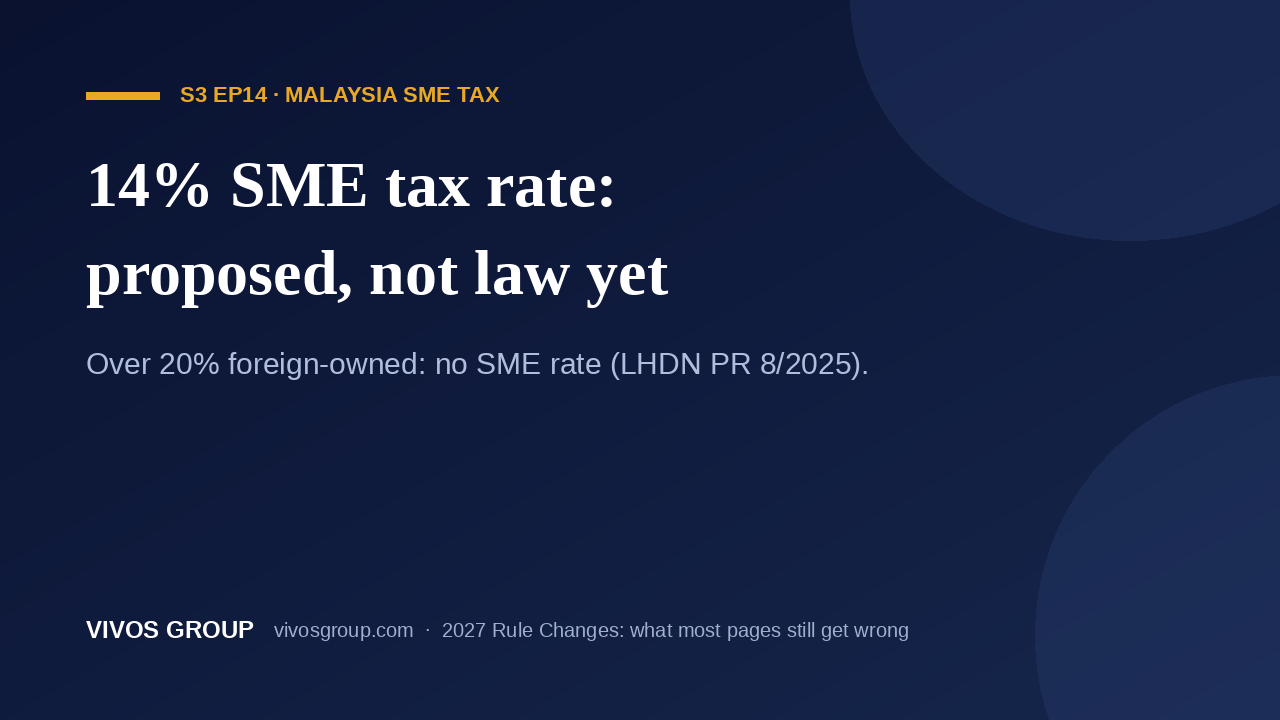
Malaysia SME tax rate 2027: Malaysia's Budget 2027, tabled on 9 October 2026, proposes cutting the small and medium company income tax rates from year of assessment 2027: 14% on the first RM150,000 and 16% on the next RM450,000, down from 15% and 17%. It is not law until a Finance Act passes. LHDN's Public Ruling 8/2025 already excludes any company more than 20% foreign-owned.
What some pages still say: "SME rates apply to companies with paid-up capital of RM2.5 million or less and annual sales of up to RM50 million." Those are the two tests in the Budget annex, often shown with 14% and 16% as settled.
What the official texts say: the Ministry of Finance's Tax Measures, Appendix 11, says "it is proposed", effective "from the year of assessment 2027". The Inland Revenue Board of Malaysia (LHDN), in Public Ruling No. 8/2025 (22 December 2025), adds a shareholding limit that Appendix 11 does not mention.
Key facts (29 October 2026)
- Malaysia SME tax rate 2027: Malaysia's Budget 2027, tabled on 9 October 2026, proposes cutting the small and medium company income tax rates from year of assessment 2027: 14% on the first RM150,000 and 16% on the next RM450,000, down from 15% and 17%.
- It is not law until a Finance Act passes.
- LHDN's Public Ruling 8/2025 already excludes any company more than 20% foreign-owned.
- A company with more than 20% of its paid-up ordinary share capital, at the beginning of the basis period, owned directly or indirectly by foreign companies incorporated outside Malaysia or by individuals who are not Malaysian citizens is not eligible for the special rates.
- Resident and incorporated in Malaysia; paid-up ordinary share capital of RM2.5 million or less at the beginning of the basis period; gross income from a business source or sources of RM50 million or less for the basis period; and the related-company test: no more than 50% owned by a company with paid-up ordinary share capital above RM2.5 million, or the reverse, or a third such company owning more than 50% of both.
What is the 20% foreign ownership limit?
A company with more than 20% of its paid-up ordinary share capital, at the beginning of the basis period, owned directly or indirectly by foreign companies incorporated outside Malaysia or by individuals who are not Malaysian citizens is not eligible for the special rates. Exactly 20% passes. In Example 15 of the ruling, a Malaysian company wholly owned by a Singapore company fails, although the Singapore company's shareholders are Malaysian citizens.
What other conditions must a Malaysian SME meet?
Resident and incorporated in Malaysia; paid-up ordinary share capital of RM2.5 million or less at the beginning of the basis period; gross income from a business source or sources of RM50 million or less for the basis period; and the related-company test: no more than 50% owned by a company with paid-up ordinary share capital above RM2.5 million, or the reverse, or a third such company owning more than 50% of both. Fail one and all chargeable income is taxed at 24%.
What are the SME tax rates now, and what is proposed from YA 2027?
15% on the first RM150,000, 17% on RM150,001 to RM600,000, 24% above. Proposed from YA 2027: 14%, 16%, 24% unchanged. The most a company could save is RM6,000 a year (RM1,500 plus RM4,500), at chargeable income of RM600,000 or more, if enacted.
Is the 14% SME rate law yet?
Proposed, not law. We found no Finance Bill for Budget 2027 on the Ministry of Finance or LHDN websites (the Dewan Rakyat bills page did not load).
What should a Malaysian company check now?
Check your share register on the first day of your basis period against these tests.
How VIVOS can help
VIVOS (M) Sdn. Bhd. (Registration No. 202501057568 (1658974-A)) in Kuala Lumpur does accounting, tax computation and filing, and VIVOS Pte. Ltd. runs the Singapore end for groups with companies in both. Talk to us on WhatsApp at +65 8827 7870 or book a free consultation. Most firms compare countries. VIVOS connects them.
Part of the 2027 Rule Changes series
This is Episode 14 of 2027 Rule Changes: What Most Pages Still Get Wrong, a VIVOS video series on dated rule changes for companies in Singapore, Malaysia, Hong Kong and the UAE. For the full evergreen guide, read Malaysia corporate tax rates for SMEs. Every dated change, with official sources, is on the 2026 to 2027 Rule Changes Tracker.
Video transcript
Will your Malaysian company pay less tax from 2027? The Budget proposes fourteen percent on the first one hundred and fifty thousand ringgit, then sixteen percent up to six hundred thousand. Only proposed. One ownership rule can keep you out.
I'm Ray Tay, co-founder of VIVOS. Many pages list only capital and sales. LHDN's Public Ruling eight of 2025 adds a limit: since year of assessment 2024, more than twenty percent foreign ownership means no special rates.
Foreign means a company incorporated outside Malaysia, or a non-citizen individual. Exactly twenty percent passes. In the ruling's example, a company wholly owned by a Singapore company fails, even if that company's owners are Malaysian citizens.
Groups face another test: a related company with capital above two and a half million ringgit must not own more than half of you. Ownership is tested at the start of the basis period.
Is it law? Not yet. Tabled on the ninth of October 2026, the cut needs a Finance Act and would apply from year of assessment 2027.
Check your share register against these tests. VIVOS Malaysia does accounting, tax computation and filing. VIVOS Malaysia in Kuala Lumpur and VIVOS in Singapore. Most firms compare countries. VIVOS connects them.
Setting up a new company in Malaysia?
If you are a foreign founder planning a new Sdn Bhd, build rules like this into the set-up plan from the start. Fixing them after incorporation usually takes longer than getting them right on day one.
Most of our Malaysia clients need two things together: a new Sdn Bhd and an Employment Pass so they can live in Malaysia and run it. VIVOS handles both. See company incorporation in Malaysia and Malaysia work visas and immigration, or read Can you get a Malaysia Employment Pass through your own company.
Frequently asked questions
Will your Malaysian company pay less tax from 2027?
Malaysia SME tax rate 2027: Malaysia's Budget 2027, tabled on 9 October 2026, proposes cutting the small and medium company income tax rates from year of assessment 2027: 14% on the first RM150,000 and 16% on the next RM450,000, down from 15% and 17%. It is not law until a Finance Act passes. LHDN's Public Ruling 8/2025 already excludes any company more than 20% foreign-owned.
What is the 20% foreign ownership limit?
A company with more than 20% of its paid-up ordinary share capital, at the beginning of the basis period, owned directly or indirectly by foreign companies incorporated outside Malaysia or by individuals who are not Malaysian citizens is not eligible for the special rates. Exactly 20% passes.
What other conditions must a Malaysian SME meet?
Resident and incorporated in Malaysia; paid-up ordinary share capital of RM2.5 million or less at the beginning of the basis period; gross income from a business source or sources of RM50 million or less for the basis period; and the related-company test: no more than 50% owned by a company with paid-up ordinary share capital above RM2.5 million, or the reverse, or a third such company owning more than 50% of both. Fail one and all chargeable income is taxed at 24%.
What are the SME tax rates now, and what is proposed from YA 2027?
15% on the first RM150,000, 17% on RM150,001 to RM600,000, 24% above. Proposed from YA 2027: 14%, 16%, 24% unchanged.
Is the 14% SME rate law yet?
Proposed, not law. We found no Finance Bill for Budget 2027 on the Ministry of Finance or LHDN websites (the Dewan Rakyat bills page did not load).
What should a Malaysian company check now?
Check your share register on the first day of your basis period against these tests.
Sources (29 October 2026)
- Ministry of Finance Malaysia, Budget 2027 portal (tabled 9 October 2026)
- Budget 2027 Tax Measures, Appendix 11 (PDF)
- Langkah Cukai, Lampiran 11 (Bahasa Malaysia, PDF)
- Budget 2027 speech (PDF)
- LHDN Public Ruling No. 8/2025, Tax Treatment for Micro, Small and Medium Companies (PDF)
- LHDN public rulings list
- LHDN Budget page
Reviewed by Ray Tay, VIVOS. Ray Tay is co-founder of VIVOS, a corporate services group with its own licensed entities in Singapore, Malaysia, Hong Kong and the UAE. General information only, not legal or tax advice. The video is presented by an AI-generated avatar and voice of Ray Tay; content written and fact-checked by VIVOS.